Understanding art therapy for emotional healing
When you think about healing in recovery, you might first picture talk therapy, support groups, or medical care. Art therapy for emotional healing adds another dimension. It gives you a way to express what feels too complex or painful to put into words, using images, colors, and symbols instead of sentences.
Art therapy is a form of psychotherapy that uses active art making and the creative process to help you express emotions and experiences that are difficult to talk about. The focus is on healing through the process, not on creating a “good” or “beautiful” piece of art [1].
In recovery, this can be especially powerful. Addiction, trauma, and family pain often involve shame, secrecy, and emotional numbness. Art therapy helps you gently approach those places without being overwhelmed by language or pressured to “explain” everything at once. It also fits naturally into a broader approach that may include holistic therapy for addiction recovery, mindfulness, family counseling, and spiritual growth.
How art therapists support your healing
Art therapy is not just arts and crafts. It is a clinical mental health profession guided by trained practitioners. Art therapists are clinicians with master’s level or higher degrees in both art and therapy. Their work supports emotional, mental, and physical well being for diverse groups, including children with behavioral challenges, adults with trauma histories, and older adults living with dementia or Alzheimer’s disease [2].
To become an art therapist, a person must complete a graduate level art therapy program that includes:
- Coursework in art therapy methods and techniques
- Training in developmental and abnormal psychology
- Supervised clinical practice totaling at least 700 hours (100 practicum, 600 internship)
These accredited programs prepare therapists to use art making within a psychotherapeutic relationship and a research based framework so that you are not just “doing art” but engaging in a structured healing process [2].
After graduation, art therapists can pursue national credentials and state licensure. This allows them to offer clinically effective services in hospitals, treatment centers, community agencies, and private practice, always with emotional healing as a central focus [2].
What happens in an art therapy session
If you have never experienced art therapy, it can help to know what to expect. A typical session includes three main parts: arriving and grounding, creating, and reflecting.
Arriving and setting intention
You and your therapist might begin with a brief conversation about how you are feeling and what has been coming up in your life or in treatment. Sometimes this includes brief breathing or mindfulness exercises, especially when art therapy is integrated with mindfulness-based relapse prevention or meditation for emotional regulation.
Together, you may identify an intention for the session, such as:
- Exploring a recent trigger or craving
- Making sense of a relationship pattern
- Processing a painful memory
- Finding some calm in the middle of emotional chaos
Creating through prompts and materials
Next, your therapist offers a prompt for creative expression. This might be open ended, like “draw how you are feeling right now,” or more structured, such as “create an image of your safe place” or “show what recovery looks like to you.”
You may work with:
- Drawing or painting materials
- Collage and mixed media
- Clay or other sculpting materials
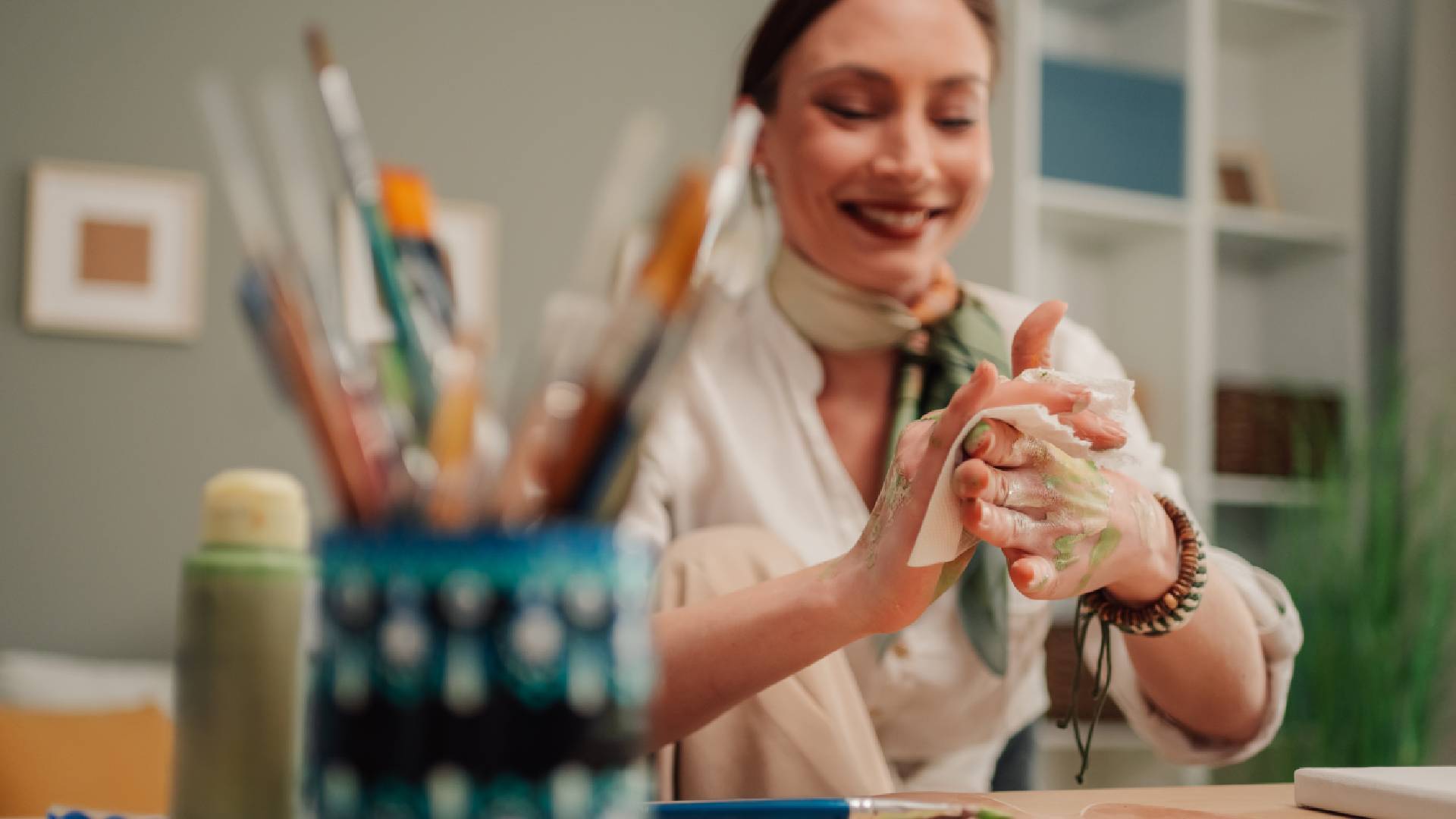
- Simple craft making or visual journaling
Art therapy uses these creative activities to help you understand your thoughts, emotions, and experiences, which builds insight and supports emotional regulation. This can be especially helpful when traditional talk therapy feels too intense, too abstract, or simply out of reach in the moment [3].
During this creative time, you are not graded or judged. The goal is not perfection. It is honest expression and curiosity about what emerges.
Reflecting and discovering meaning
After the art making, you and your therapist look at the piece together. The therapist may ask gentle questions:
- What drew you to these colors or shapes?
- What stands out to you as you look at this now?
- If this image could speak, what might it say?
This joint reflection helps uncover symbolic meaning and therapeutic insight while keeping you anchored in the present. It offers a healing space if you feel overwhelmed by language or struggle to explain your inner world logically [3].
Emotional benefits of art therapy in recovery
Art therapy for emotional healing can support your recovery in several interconnected ways. You may notice changes in how you experience your feelings, your body, your relationships, and your sense of self.
Expressing what words cannot reach
Addiction and trauma often involve experiences that are confusing, fragmented, or too painful to describe. Art gives you another language. You can:
- Externalize fear, shame, or grief onto paper or canvas
- Approach difficult memories more indirectly and safely
- Revisit experiences at your own pace
Research shows that creative art therapy can significantly reduce negative emotions and increase positive emotions. For example, a study of cancer patients found that four guided drawing sessions improved psychological well being by decreasing distress and increasing positive feelings [1].
Regulating anxiety, depression, and stress
In recovery, you may face waves of anxiety, sadness, or agitation. Focused creative work can redirect your brain’s attention from anxious rumination to the present moment, which reduces the intensity of distress [3].
A large review of visual art therapies, including drawing, painting, and craft making, found that these approaches help people express themselves freely, enhance emotional awareness, reduce stress, and improve relationships [4].
A 2022 randomized controlled trial showed that art therapy activities like weaving, collage, clay modeling, drawing, and painting reduced symptoms of depression and anxiety in people receiving medication for major depressive disorder [4]. This suggests art therapy can be a meaningful adjunct to medical and psychotherapeutic treatment.
Building healthier emotion regulation skills
If you have lived with anxiety disorders, panic, or chronic stress, you may have learned to avoid or numb your feelings. Art therapy helps you build skills instead of relying on substances or destructive behaviors.
Research indicates that art therapy can improve emotion regulation in people with anxiety disorders, including gains in accepting emotions and staying engaged in goal directed behavior, even when distressed [4].
In practice, this might look like:
- Noticing what sensations arise in your body as you create
- Learning to stay with discomfort a little longer while still feeling safe
- Using art making as a grounding tool when you feel triggered
These same skills can support you outside sessions, especially when combined with holistic mindfulness addiction care, breathwork therapy for recovery, or yoga therapy in addiction treatment.
Art therapy as trauma-informed experiential healing
Trauma is often stored both in the body and in images and sensations rather than in words. Trauma focused art therapy (TFAT) uses the nonverbal, experiential nature of art to help you safely externalize and process those experiences.
A 10 week TFAT model being studied in the Netherlands uses three structured phases:
- Stabilization and symptom reduction
- Expressing and exploring traumatic and positive memories with various art materials
- Integration and meaning making by arranging and reflecting on the completed artworks [5]
Preliminary pilot studies show that participants experienced decreased PTSD symptoms, increased self expression, and better emotion regulation, particularly when they had not responded well to strictly verbal therapies [5].
You might encounter specific trauma informed art exercises such as:
- Safe place drawing, where you visualize and create an image of a safe, calm location you can “visit” when triggered [6]
- Body outline, where you trace your body and mark physical sensations or emotions, helping reconnect body awareness with emotional understanding [6]
- Trauma timelines, where you represent key life events with colors or symbols to see patterns and themes more clearly [6]
These approaches align closely with experiential therapy for trauma, where you heal not just by talking about the past but by engaging your body, senses, and creativity in the present.
How art therapy fits into holistic recovery
Art therapy is most powerful when it is part of a larger, integrative plan. You are not choosing between art therapy, talk therapy, or medical treatment. You are combining them so each strengthens the others.
In a holistic wellness recovery program, art therapy may be woven together with:
- Individual and group counseling
- Spiritual therapy in recovery or faith-based holistic recovery
- Music therapy in addiction recovery and creative therapy for addiction recovery
- Mindfulness, meditation, and yoga practices
- Family and couples work to address relational patterns
Research supports using art therapy as an adjunct, not a replacement, for other care. A 2022 review found that art therapy works well alongside psychotherapy and cognitive behavioral therapy for mood disorders, anxiety, and emotional trauma [4]. Another review concluded it is a low risk, high benefit intervention that helps people with serious mental illness reduce symptoms and improve functioning [1].
This integrative approach respects you as a whole person, not just a diagnosis or a “case.” It recognizes that emotional, spiritual, relational, and physical healing are deeply linked.
When you give yourself multiple pathways to healing, you increase your chances of staying engaged in recovery and finding what truly resonates with you.
Supporting family systems through art therapy
Addiction rarely affects just one person. It ripples through the entire family system. Art therapy can become a bridge for communication and healing when words feel tangled or defensive.
Art in family sessions
In family or couples sessions, an art therapist might invite each person to:
- Draw or sculpt how they see the family right now
- Create an image of their role in the family during the addiction
- Show what hope or healing would look like moving forward
Then, each person shares what they created and what it means to them. This often reveals hidden emotions, misunderstandings, and long held hurt in a way that feels safer than direct confrontation. It also supports the goals of family therapy in addiction recovery and integrative therapy for families.
When families are navigating trauma, neglect, or abuse, art exercises can provide a gentler entry point than immediate verbal disclosure. This aligns with trauma-informed family counseling and family education for addiction healing, where the focus is on understanding patterns and building compassion.
Group murals and shared projects
Collaborative art projects, such as group murals, clay installations, or shared collages, can help families or groups of loved ones:
- Experience connection rather than isolation
- Practice listening and compromise as they plan and create together
- Visualize shared values, hopes, or commitments
In trauma recovery settings, group murals have been used to foster a sense of connection and mutual support among people with shared histories [6]. The same principle applies to families healing from addiction. Creating something together makes the abstract idea of “rebuilding trust” tangible.
These processes also strengthen group therapy for family healing and encourage ongoing family involvement in relapse prevention.
Combining art, mindfulness, yoga, and music
Experiential therapies often work best in combination. When you pair art therapy with mindfulness practices, movement, or sound, you give your nervous system multiple routes to safety and regulation.
For example, a day in a holistic program might include:
- Morning yoga therapy in addiction treatment to release physical tension and reconnect with your body
- Midday art therapy focused on expressing current emotions or recovery themes
- Afternoon music therapy in addiction recovery to explore rhythm, voice, and connection in a group setting
- Evening meditation for emotional regulation or gentle breathwork therapy for recovery
This layered approach supports:
- Better sleep and reduced need for medication in some hospital based settings [1]
- Reduced caregiver stress and anxiety for those supporting loved ones with long term illnesses [1]
- Improved quality of life in people living with dementia or Alzheimer’s disease through art activities like painting, pottery, and collage [4]
Experiential work can also extend beyond the therapy room through an outdoor experiential recovery program, where you might incorporate nature based art, photography, or land based rituals as part of healing.
Using art therapy to strengthen your long-term recovery
Art therapy for emotional healing is not limited to early treatment. It can support your ongoing recovery, spiritual life, and relationships over time.
Creating a personal practice
With guidance from your therapist, you can develop simple creative practices you use at home, such as:
- A visual recovery journal where you sketch or collage your feelings each day
- A “toolbox” of grounding images you can revisit when you feel triggered
- Rituals of drawing, painting, or sculpting before or after challenging conversations
Strengthening your support system
As you share selected artworks with trusted family members, peers, or support groups, you invite more honest conversations about your inner experience. This can:
- Deepen empathy and understanding among loved ones
- Support ongoing family involvement in relapse prevention
- Make it easier to ask for help before a crisis
In this way, art becomes part of your relational safety net, not just a solitary activity.
Art therapy offers you a way to see, feel, and transform what might otherwise stay hidden. When it is integrated with counseling, mindfulness, family work, and other experiential therapies, it can strengthen every layer of your recovery.
You do not need to be an artist to benefit. You only need a willingness to be curious about what your hands, your imagination, and your heart are trying to say.